
Marinoni Ensemble Homes listed on National Historic Register
-

The Marinoni Ensemble Homes, which now houses our offices, was named to the National Register of Historic Places this month. The property is a distinctive five-unit Tudor Revival residential complex developed, designed, and supervised by Rosa Zagnoni Marinoni, better known as Arkansas's first Poet Laureate than as a real estate developer.
The five dwelling units were named Annette, Cecile, Emilie, Marie, and Yvonne after the Dionne Quintuplets, whose 1934 birth attracted international attention during the Great Depression.
The History
Rosa Zagnoni Marinoni purchased the undeveloped property on the Washington County Courthouse steps on January 9, 1935, for $2,300 and notably held it solely in her own name. After construction of the Marinoni Ensemble Homes in 1935, the units were listed for rent as residences. Marinoni sold the property on September 24, 1969, to Herbert Hatfield for $53,000 and it was used as the offices for his car lot on a neighboring parcel. Since 1981, Stafford and Associates have occupied the building and it has become known as the home of the Star Shopper, a weekly newspaper founded by Joyce and Bert Stafford that advertises real estate, automobiles, and other merchandise for sale in the local area. In 2026, the property was purchased by Allison Thurmond Quinlan, an architect, landscape architect and, like Rosa, a small scale developer.

1935 watercolor delineation by local architect Belle Dinwiddie, likely used to inform construction.
The structure was originally designed as five attached townhouses composed to read as a single, large residence.
The developer, Rosa Zagnoni Marinoni, wrote in 1941, "The drawing of the plans of the Marinoni Quintuplet. Five homes in one, standing beneath the sweep of one roof, which gives the structure the appearance of an imposing mansion, with a frontage of about one hundred feet, centered by a chimney of Carthage stone. Arched entranceways, gray manganese brick, blue shutters. Motifs of blue and black mosaic are encrusted above the arched windows. The porch and verandas have Terrazzo blue tile floors. The blue slant of roof that runs like a scenic railway to dip over an arch way. This is the Quintuplex, which was opened for occupancy on the first birthday of the Dionne quintuplets."

You can still see those mosaics positioned above three front windows. These panels have a field of small mosaic turquoise glazed tiles with a larger central tile featuring a standing lion, a motif from the Zagnoni coat of arms (Marinoni’s father's family). These exterior tiles, along with handmade tiles incorporated into fireplace surrounds, were likely created by Marinoni herself, as they resemble tilework on Villa Rosa, her own home.
The kitchens and several of the porches were provided with terrazzo flooring - a tie to Marinoni’s native home, Bologna, Italy, where terrazzo is used extensively, even on the sidewalks. While four of the five kitchens have had linoleum installed covering the terrazzo floors, we are currently restoring those floors and restoring the terrazzo.
About the Developer
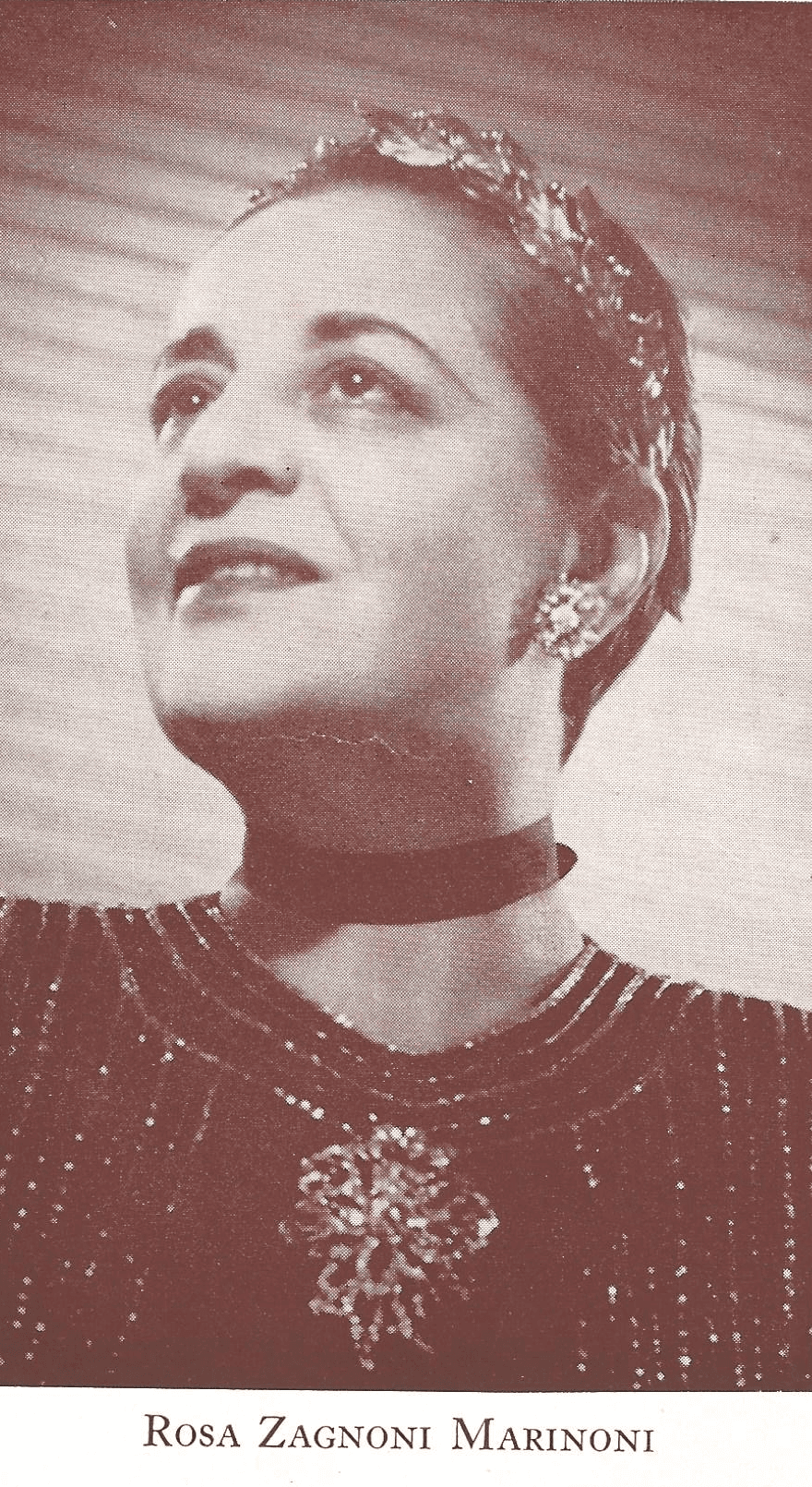
Rosa Zagnoni Marinoni (1888–1970) was one of Arkansas’s most influential cultural figures, serving as poet laureate of Arkansas from 1953 until her death in 1970. During her long tenure, she worked consistently to expand public engagement with poetry, to support emerging writers, and to institutionalize poetry as a civic and educational activity within the state. She also developed several unique residential buildings in Fayetteville, Arkansas.
She was born in Bologna, Italy, on January 5, 1888, into a family deeply engaged in literary and artistic pursuits. Her father, Antero Zagnoni, worked as a journalist and drama critic. Her mother, Maria Marzocchi, was a poet and artist, and her uncle, Federico Marzocchi, was also a poet. She came to this country with her parents in 1898 when her father, a journalist, initially was to cover the Spanish-American War for three leading European newspapers, never intending to stay.
On July 30, 1908, she married Antonio Marinoni in Brooklyn and soon after moved to Fayetteville, Arkansas, where Antonio - known to all as Signior - was a member of the faculty of the University of Arkansas. Signior Marinoni had founded the Department of Romance Languages in 1906 and was department head until his retirement in 1944. The Marinonis maintained strong ties to Europe, and beginning in 1922, Antonio organized and led summer educational tours in Europe for the general public until war in Europe paused the tours in 1938 (three years after the Marinoni Ensemble Homes were completed).
The couple had four children, twin daughters and two sons, though two of the children died in infancy. After a fire destroyed the family’s earlier residence in 1924, Rosa Zagnoni Marinoni commissioned a new Mediterranean-style home known as Villa Rosa. Built in 1924 at 617 West Lafayette Street, the two-story house became the center of their personal and professional life for decades. It was later added to the National Register of Historic Places in 1990 for its architectural character and its association with Rosa Zagnoni Marinoni. The home is owned by her granddaughter – biographer and archivist Paula Marinoni.
Rosa Zagnoni Marinoni began her writing career in 1925 while recovering from a near fatal auto accident in a hospital bed, marking the start of a remarkably prolific output that included short stories and poetry. Over the next forty-five years, she published twelve volumes of poetry, starting with Behind the Mask in 1926. She also published more than 1,000 short stories, vignettes, serials, novels, and epigrams across more than 500 magazines worldwide, establishing herself as a versatile contributor to popular periodicals of the era Her 1938 collection of poetry, Side Show, became one of the best-selling books of poetry of all time (and would have been written in the era in which she was building the Marinoni Ensemble Building). Her works were translated into French, German, Italian, Danish, Yiddish, Gaelic, Welsh, and Russian. In the 1950s, the Italian government recognized her as the most widely known poet of Italian birth abroad.
Rosa Zagnoni Marinoni became an active figure in Fayetteville’s cultural life. In 1926, she founded the University-City Poetry Club, which met regularly at her home, Villa Rosa, near the university for the next forty-five years. The club functioned as a working literary forum, with members submitting their writing for critique and discussion. At least eighteen collective volumes of club members’ work were published over time. Rosa Zagnoni Marinoni was especially committed to mentoring young and inexperienced writers, including Arkansas poet Edsel Ford.
Her organizational work extended beyond Fayetteville. She was a founder of the northwest Arkansas affiliate of the National League of American Pen Women and collaborated closely with the Arkansas Federation of Women’s Clubs, now known as the General Federation of Women’s Clubs of Arkansas. Through these networks, she promoted poetry through schools, women’s organizations, newspapers, and public events. These efforts culminated in Governor Ben Laney’s proclamation of October 15, 1948, as the first annual Poetry Day in Arkansas. Rosa Zagnoni Marinoni continued to observe the day annually by recognizing three Arkansas poets, representing past achievement, contemporary work, and future promise.
Although she arrived in Arkansas as a cultural outsider, Marinoni became an energetic interpreter and promoter of the state’s literary and regional identity. In 1954, she was named an Arkansas Traveler, an honorary designation recognizing service as an ambassador of goodwill. Between 1956 and 1967, she published a sequence of works commonly referred to as the Ozark Series, including The Ozarks and Some of Its People (1956), The Ozarks and Some (More) of Its People (1958), Lend Me Your Ears!: A Beakfull of Humorous Verse (1966), and Whoo-Whoo the “Howl” of the Ozarks Says: Think and Wink! (1967).
The Arkansas General Assembly formally named Marinoni poet laureate on March 28, 1953. She held the position until her death. In 1969, Governor Winthrop Rockefeller issued a proclamation designating October 15 as Rosa Zagnoni Marinoni Day, coinciding with the annual observance of Poetry Day in Arkansas.
Rosa Zagnoni Marinoni died on March 26, 1970, in Fayetteville, Arkansas, and was buried in the city’s Catholic cemetery.
Other RZM Real Estate Projects
There are two other extant examples of Rosa Zagnoni Marinoni’s creative direction and Frank Kelly’s masonry in Fayetteville, and at least two other examples that have been demolished to make way for University of Arkansas expansion:
· Villa Rosa (built 1924): home built by the Marinonis in Italian Renaissance style but sharing many material selections and a notable European detailing with the Marinoni Ensemble Homes.
· 920 W. Maple Avenue, Tri Delta Sorority House (built 1930): Featuring similar brickwork and incorporating dramatic accents including arches and towering gothic windows, which were donated to the project by Marinoni.
· A duplex on Reagan Street: featured ornate yellow brick masonry. This structure was demolished in 2016.
· Heart’s Desire (Completed early 1935, just before work commenced on Marinoni Ensemble Homes): A model home featuring detailed masonry, many arches, and an arched-top chimney similar to the chimney of the Marinoni Assemble Homes.
We are grateful to Paula Marinoni, Rosa's granddaughter, for her generous help in documenting the history of the Marinoni Ensemble Homes.